Wednesday, 14 October 2015

Cuckoo Song


After a mostly glorious and golden beginning to October, today was the first day when I really felt the in-betweenness of the seasons.  The wind, brisk and biting, definitely had the chill of winter.  I have been reading lots of ghost stories lately -- not really my favourite genre, but I like them when the "ghost" is more of a subtle, symbolic thing.

Halloween and Guy Fawkes Day and Remembrance Day have a tendency to slide together in England, as they all take place within two weeks and just at that time of the year when Daylight Savings conspires with the natural dying of the day and plunges us all into darkness.  If you really want to go with that mood, I don't think you can do much better than Frances Hardinge's Cuckoo Song.

There is a ghost in the house at The Beeches, Luther Square, Ellchester.  The father of the house may be Mr. Piers Crescent, civil engineer and designer of the railway bridges and station which will save Ellchester, but he hasn't been able to save Sebastian -- his oldest child, and only son, who died in the final months of the Great War.  Although Mr. Crescent has done his best to stop time, and wrap his daughters Triss and Pen in cotton-wool, he has made something of a bad bargain (literally) with a sinister Architect.  The entire family has been arrested in a prolonged state of grieving, and the inability of the parents to let go of their dead son has lead, directly, to the events which take place in this novel.

The War had ended, but it was not gone.  Somehow it was still everywhere.  Sebastian was the same. He had ended but he was not gone.

Like all the best children's books, this book operates on two levels -- thus making it appropriate for ALL ages. On the more surface level, this book is about a changeling (a "cuckoo") who is substituted for a real girl. Only gradually does "Triss" realise that she is actually a not-Triss -- and just a "monster" or made-up thing with an expiration date.    Unlike the real Triss, not-Triss (who later becomes Trista) is "allowed" to be something other than the "sweet, quiet, well-behaved girl" that her parents expect and want.  She has agency; she does things and makes things happen.  She eats dolls instead of playing with them.   Somewhat like Alice's Adventures in Wonderland, not-Triss ventures into an alternate world -- the world of the Besiders -- and uses her wits to bargain for something which will change the outcome of not just her brief existence, but lots of other realities, too.

But there is a more complex level to this book; truly,  I think that all of the best fantasy novels have that ability to throw some light on what we like to call the "real" world.  That aspect of the book deals with the aftermath of World War I and how it impacts not just one grieving family but an entire society. The novel manages to take in the changing role of women -- and there is fascinating commentary here about the "containment" of the feminine -- but also how the war changed the "certainties" (religious faith and class structure) of the country.

One of the subversive female characters is Violet Parish, the former fiancĂ©e of Sebastian.  She has bobbed hair, rackety friends, a variety of short-term jobs and she drives a motorcycle; she drinks and smokes and is generally "fast".  She also takes in Pen and Triss when no one else will.


Once she had been 'Violet'.  After Sebastian's departure she had been 'poor Violet'.  And then somehow, in the years since his death, her name had blackened and speckled in Triss's family home, like a fruit left to rot, until it was thrown out and no longer allowed in the house.
A specific pleasure of this book is the quality of the writing; Hardinge has a wonderfully expressive way with words.  I cannot think of another writer who uses figurative language with such fresh precision.  I felt, often, the urge to copy sentences and paragraphs down -- to capture the words for myself -- just because they pleased me so much.   It wasn't a book that I would have sought out if left to follow my usual tastes, but it was a suspenseful, thoughtful and pleasurable reading experience.


Click icon for more
book review blogs
@Barrie Summy

Wednesday, 7 October 2015

Feminism in UKYA


“We need to reclaim the word 'feminism'. We need the word 'feminism' back real bad. When statistics come in saying that only 29% of American women would describe themselves as feminist - and only 42% of British women - I used to think, What do you think feminism IS, ladies? What part of 'liberation for women' is not for you? Is it freedom to vote? The right not to be owned by the man you marry? The campaign for equal pay? 'Vogue' by Madonna? Jeans? Did all that good shit GET ON YOUR NERVES? Or were you just DRUNK AT THE TIME OF THE SURVEY?” ― Caitlin MoranHow to Be a Woman


Feminism has been a contentious word for a while, and many young women seem to associate it, pejoratively, with certain outmoded ideas:  man-hating, for instance, or hairy armpits.  Women who define themselves as feminists are considered seriously unattractive -- or unattractively serious -- as if they can be conflated into much the same affliction.  What is even more troubling, at least to me, is that population of women/girls who think that feminism is no longer necessary because the "battle for equality" has already been won.  And yet, so many of the statistics that make up our lives (e.g., equal pay, sexual violence, rights over our own bodies) suggest otherwise.

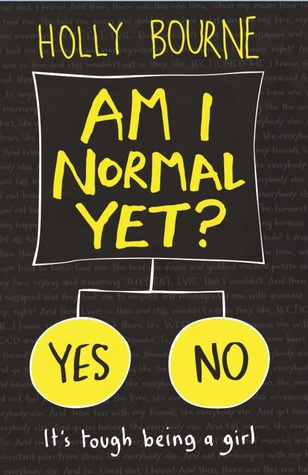
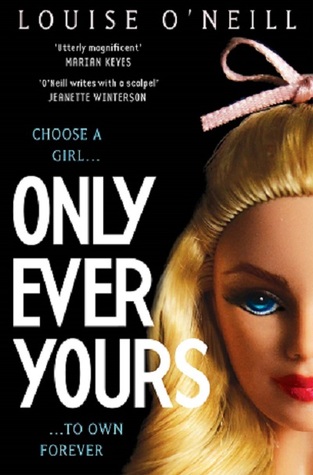
In the past year, I've read some really strong UKYA books that take on feminist issues in ways that are brave, honest, provocative and deeply thoughtful.  These books are holding a mirror up to our society and showing us exactly how much work still needs to be done.  The word "feminism" certainly never appears in the speculative dystopia that is Only Ever Yours, but O'Neill gets her message across more than effectively.  The mirror she holds up is distorted, definitely, but anyone should feel the horror of recognition of what shows up there.  Am I Normal Yet? takes a more straightforward approach and engages in up-front consciousness raising.

Margaret Atwood's The Handmaid's Tale was the cautionary tale for my generation of young women seguing into adulthood.  Written in 1986, my first year at university, Atwood's influential dystopia imagined a poisoned world where the birth-rate has fallen to an alarmingly low "no replacement" level.  Although the true cause of widespread sterility was more to do with chemical warfare, women get scapegoated.  The pill, abortions, educated women wanting to work rather than be mothers: all of this dangerous reproductive freedom is held up for blame.  And then it is all taken away.  Before long, women have no control over their own bodies; if they are fortunate enough to be fertile, they become vessels -- willing or not -- for childbirth

Atwood was writing in a post Roe v. Wade world, after the first (or arguably the second) wave of feminism.  She noted the growing popularity of fundamental Christianity, and her novel served as a warning that hard-won rights for female equality were a slippery slope -- and that it was frighteningly possible to slip backwards.

As I was reading Louise O' Neill's Only Ever Yours  -- which contains such deliberate parallels to Atwood's dystopic vision that it has been marketed as "A Handmaid's Tale meets Mean Girls" --  I kept thinking about Atwood's warning to women.   In both dystopias, women are reduced and confined to one of three roles:  wife/companion, concubine, or chastity/"martha" (in essence, a  desexualised cross between a nursemaid and a prison warden). They are a sisterhood which is divided in every possible way and exists only to please and serve men.

Although the creeping religious fundamentalism that Atwood identified has certainly manifested itself, perhaps even more obviously in the Islamic faith than the Christian, the most profound cultural influence of our age has been distinctly secular:  the rise of narcissism.  Social media, reality television, selfies, You-Tube, the popularity of the Kardashians, and the list could go on and on.  Can anyone under the age of 30, can anyone at all, escape from the picture-taking mirror we keep gazing into?  Our smart-phone cameras are mediating our entire existence.  The importance of physical appearance, the relentless pursuit of physical perfection and constant self-promotion are our culture's new holy trinity.  Only Ever Yours  is a truly frightening book, not only because it imagines what we could could become -- but because it identifies (and satirises) so accurately what we already have become.  When the narrator of  Only Ever Yours is punished, her internet privileges are taken away.  It is as if her very self is being erased.  "The need to record my life is as fundamental as my need to breathe.  Without MyFace, I'm floating.  I have nothing to anchor me down, to prove I exist."

In O'Neill's dystopia, women have been genetically engineered to the point that any notion of diversity has been almost entirely lost.  As with Barbies, the prototype is exactly the same with slight adjustments in eye, skin and hair colour.  Women, who are called "eves" and numbered like prints in the same series, read like a paint chart.  Isabel, or rather"isabel", as women are never dignified with capital letters, is described as:  PO1 Metallic Silver hair and #76 Folly Green eyes.  Although the girls are told that they have been "perfectly designed", they are constantly exhorted to improve themselves.  But that quest for improvement is limited, entirely, to physical appearance -- obvious intelligence, or any attempts to cultivate the mind, are discouraged.  Curiosity, like anger, is an "unacceptable emotion".   Every week the girls are ranked, according to attractiveness, and there is constant competition with no prize at the end. Although they are meant to be happy and positive, they live a goldfish bowl existence of staring at themselves all day and seeing nothing but flaws, magnified.  Eating disorders and self-harm, as exemplified by isabel, are the only outlets for mental pain -- and the only ways in which the girls can "own" or control a body that has been created for a man's eventual use.

One of the most painful aspects of the society described in Only Ever Yours is the way that women are pitted against each other in an endless beauty contest.  There is no way for friendship to survive in an atmosphere of constant competition.  The Queen Bee character is called megan, and her cunning manipulations were almost unbearable to read.  It was only after I finished the story, and had some distance from it, that I could partly admire megan for the way she utilises personal power in a pretty powerless situation.

Am I Normal Yet? is a very different kind of book from Only Ever Yours, but in many ways it is examining exactly the same kinds of pressures that are brought to bear on adolescent girls (not to mention grown-up women).  Both books show how females mentally flay themselves with negative scripts, especially ones that have to do with being attractive and/or worthy of love.  Both books deal with mental illness.  Perhaps the major difference between the books -- other than the tone, of course, because one is a dystopia which makes its point through cruel satire while the other is both humorously and earnestly realistic -- is in the portrayal of female friendship.

The protagonist of Am I Normal Yet? is Evie, a 16 year-old girl who has just started Sixth Form College.  Evie is hopeful that a new school will be a fresh start for her, but she is hiding a big secret: she suffers from Obsessive Compulsive Disorder (OCD) and Generalised Anxiety Disorder.   Evie is on medication and sees a therapist regularly, but she feels constant anxiety about being able to maintain the "illusion" of "being normal".  When she makes new friends, specifically Amber and Lottie, she suppresses the truth about what she has suffered:  "mainly because they seemed to like who I was and I didn't want to tarnish the illusion."

One of the big themes in Am I Normal Yet? is the relationship between the sexes.  For Evie, part of being "normal" is being in a romantic relationship -- but she keeps butting up against the harsh reality that teenage boys don't necessarily want the same things as teenage girls do.  Evie and her friends set up a feminist support group, which they jokingly refer to as The Spinster Club, but while they discuss a variety of feminist issues, they ruefully acknowledge that the conversation seems to keep veering towards boys and the mixed signals they send.  At the beginning of the book, Evie's therapist warns her against relationships with teenage boys:  "they can make you overthink and overanalyse and feel bad about yourself . . . and they can make even the most 'normal' girls feel like they are going crazy."

The girls are pretty clued-up on not relying on boys for their own self-esteem, and yet the progress of the plot makes it clear that being jerked around tends to trigger negative mental scripts -- especially for Evie, who is quite vulnerable to the bad voices in her head.  This book is terrific for educating readers about mental illness -- the character of Evie definitely "normalises" her condition by describing its symptoms and treatment in a very relatable way -- but one of the most interesting things it does it connect mental illness with the historical treatment of women.  At the end of the novel, Evie makes the point that women are far more likely to suffer from certain types of mental illness -- depression, eating disorders, self-harm -- and that they turn powerlessness inwards. "I believe the world, our gender roles, and the huge inequality we face every day MAKES US crazy," Evie tells her friends in an impassioned speech at the end of the book.  

The female friendships that Evie makes are an important part of her support system; being able to finally confide in Amber and Lottie is part of her growth.  The book sends a strong message that female solidarity is of paramount importance to female mental health.  If women don't stick up for each other, who else is going to do it?


Only Ever Yours can be found on TRAC's Fantasy reading list  and  Am I Normal Yet? can be found on TRAC's Overcoming Adversity reading list.

Author Holly Bourne runs The Site, an advice and information forum for young women.


Friday, 14 August 2015

LGBT themes in contemporary YA


I recently reread that classic YA novel The Catcher in the Rye-- one of my own adolescent favourites -- for the first time since the 1980s.  According to The Guardian, it ranks as the 72nd best novel of all time.  Robert McCrum's excellent short piece on the "defining novel of teenage angst and alienation" happens to mention that "by 1981, it was the second most taught book in the United States." Certainly it was on the required reading list of my small town Texas high school -- despite the drinking, smoking, sex and profanity that made the book so infamous.  A friend who observed me reading the book wondered if I found it "dated" in 2015.  The truth is that its 1949 New York City setting was already "historical" when I was reading the book in 1981. The way that Holden spoke, the particular slangy language he favoured, was already unrecognisable to a 1980s teenager. But the eternal, durable qualities of the book -- mostly the poignant, hilarious, distinctive voice of Holden Caulfield -- were pretty much intact in 2015, and not much diminished since my first reading experience.  The only aspect of my rereading that I found really quite different was my awareness of an undercurrent of homosexuality running through the book.

Towards the end of the book, Holden spends the night with one of his former teachers -- a Mr. Antonlini, who is presented is a heavy drinker recently married to an older woman "lousy with dough".  Holden wakes up on the couch to discover that Mr. Antonlini is "sort of petting me or patting me on the goddamn head".  Holden bolts from the apartment in a complete panic, even though it is the middle of the night.  Although he acknowledges that he might have misinterpreted the situation -- thus, making it grey area for the reader's interpretation as well -- he also comments that "when something perverty like that happens, I start sweating like a bastard.  That kind of stuff has happened to me about twenty times since I was a kid.  I can't stand it." (p. 174)

My intention is neither to prove or disprove Holden's possible homosexuality -- although this blog post makes a really plausible case for the former, if you are interested -- but rather to point that how very much the world has changed since The Catcher in the Rye was published in 1951 . . . or even since I first read the novel in 1981.  Did I pick up on Holden's "protest too much" diatribe against all things "perverty" as ambivalence when I first read the book?  It's doubtful.  At the time, one of my best friends was a lesbian -- not that we even had a word for it, much less realised that her unhappiness might have something to do with repressed sexuality.  I thought she was a "punk" -- mostly because she favoured safety pins as a fashion accessory and was the only person I knew who listened to The Sex Pistols and the Dead Kennedys.  She was the first person I knew who self-harmed, and we didn't have a word for that, either.

The present generation of 13-25 year olds live in an entirely different world when it comes to LGBT rights and self-expression.  June, 26, 2015 was the landmark date on which the United States Supreme Court ruled in Obergefell v. Hodges that same-sex marriage cannot be prohibited by a state.  Considering that homosexual activity was illegal during 1951, and indeed not technically legal in all states until June 26, 2003, a mere 12 years in a nation's history are the entire formative years of a present-day 25 year-old.  What might seem a gradual softening of attitude to a 45 year-old or a 70 year-old is just the way it has always been to someone who is currently 15 years-old.  No surprise then that the current generation of adolescents are entirely more comfortable with, and approving of, LGBT rights than previous generations.  This is certainly reflected in YA fiction.

One of the reasons that Holden's discomfort with "perverty" behavior so jarred is that I read The Catcher in the Rye just after completing a reading list of contemporary realistic fiction.  In I'll Give You the Sun, the male protagonist falls in love for the first time -- and has his feelings returned, although the baseball player that he falls for must battle some homophobic attitudes in the sports world.  In Grasshopper Jungle and This Is Not a Love Story, the main characters experience their sexuality as a bisexual spectrum.  Although having sexual feeling for both sexes is not presented as unproblematic, it is definitely presented as something entirely normal and typical.  In Me Being Me is Exactly as Insane as You Being You, the protagonist's father has come out as gay -- which has precipitated the parents' divorce.  Although the young male narrator has some discomfort with this change in his life, as I said in my review of this book, the discomfort is more to do with change in general than his father's homosexuality in specific.  Recently I read Holly Black's new fantasy novel The Darkest Part of the Forest in which a faerie prince is rescued by a teenage girl, but then falls in love with her older brother.  Yes, the author delights in subverting all of the usual fairy tale conventions, but she is also reflecting a world in which this outcome is seen as equally possible.

Some aspects of adolescence haven't changed all that much in the last 65 years  -- hopefully, adolescents will always be more innocent and idealistic than their life-bruised elders -- but when it comes to sexuality, it is a braver, more permissive world out there.

Visit TRAC's website to see the complete list of YA Classics and Hot for Summer contemporary fiction.

Wednesday, 17 June 2015

Me Being Me Is Exactly as Insane as You Being You


15 year-old Darren Jacobs is grappling with:
1) his parents' recent divorce
2) his father's coming out as gay
3) his body image
4) his sexual feelings
5) his confused emotions about at least 2 girls
6) the way that his parents suddenly seem like different people
7) the way that his parents have lives that don't necessarily have him at the center
8) general weirdness

Like Judy Blume, that trailblazer of realism in children's and YA literature, author Todd Hasak-Lawy speaks candidly about the body and adolescent sexual awareness.  Darren might be awkward and self-conscious and mute, more often than not, but the voice of the narrative is self-assured.  Darren's anger, confusion, contrariness and monosyllabic tendencies seem entirely appropriate for his age, gender and situation in life.

There seems to be a trend in realistic YA fiction for strong language (which was not so present in Blume's writing), sexuality and references to drugs and alcohol.  It may not be what parents want their children to read (ie, a sanitized version of of adolescent life), but it probably rings truer for the life that most adolescents are experiencing.  Also:  Is just me, or does it seem like LGBT themes and characters and storylines are really pervasive at the moment?  Fun Home just won 5 Tony awards, Caitlyn Jenner is on the cover of Vanity Fair, and the last three realistic YA novels I have read all feature a gay character -- and not even as the protagonist or the main theme, but in a studiously casual way . . . as if to say, "this is just our new normal".  Darren is not completely comfortable with his father being gay, but it's not really the homosexuality per se as much as the fact that his life is changing too quickly.  It's just one of many things that Darren is dealing with, and the storyline deals with it in straightforward, sensitive way.  Like most adolescents, (if not all), Darren is much more interested in his own sexual experiences than his father's.

It's difficult to stand out in a crowded YA field, but this book will be remembered as "the list" book -- and maybe for its catchy title (which suits a story in which there is father-son therapy and a love interest in rehab).  The narrative is told through a series of lists -- some of them brief, and some of them so lengthy that they threaten to stretch the concept to its breaking-point.  It is an arguably gimmicky way of telling a story, but it mostly works.  Much of the humour of the book takes place between the title of the lists and their contents.  It also is an efficient way of breaking up the text, which is always a plus for reluctant readers, male readers, impatient readers and readers who read a lot for their work (me).  Unfortunately, and this would be my main criticism of the book, the overall length of this book starts making even an indulgent and (mostly) entertained reader feel:  enough already.  Didn't YA books used to be between 180-200 pages on average?  Just because J.K. Rowling wrote door-stoppers that sold millions doesn't mean that every YA author needs to deliver such a high word-count.  This story would have greatly benefited from being more tightly edited.  It just goes on a bit too long, even though its separate parts are both entertaining and worthwhile.


Click icon for more
book review blogs
@Barrie Summy

Tuesday, 16 June 2015

Reading Aloud

When I was in graduate school, working on a M.Ed. in Reading Education, I was exposed to the ideas of Jim Trelease -- author of The Read-Aloud Handbook, and a tireless and inspirational promoter of reading aloud.  The Big Idea central to Mr. Trelease's philosophy is that we are more likely to do something if we find it pleasurable; ergo, if we can make reading pleasurable, then children (not to mention teenagers and adults) are more likely to do it.  There is a logical progression to this equation:  the more frequently we read, the better reader we will become.  The better reader we become, the more successful we will be at school (and also life -- as books are one of our best sources of emotional/ethical enrichment).  There is an enormous wealth of research in the field of education and it mostly boils down to this:  the more a child reads, the better.

This week the idea of "reading aloud" has resurfaced as a hot topic and Big Idea.

Tony Little, the retiring Head Master of Eton College, has published a book called An Intelligent Person's Guide to Education and one of his bits of advice to parents is this:  read aloud to your teenagers.  A recent article in The Times even led with this idea, perhaps because it is so basic and old-fashioned that it seems archaic . . . or revolutionary.  At a historical moment when many families are more likely to communicate by text than actual conversation, it is an idea that feels positively 19th century (pre-radio, pre-television, pre-computer, pre-Netflix).

The rationale for reading aloud has always been clear:  in the words of Mr. Little, reading aloud "develops listening skills" (which surely are on the wane) and it "fosters a love of literature". Also, when children/teenagers are read aloud to, it kindles their interest.  Over and over again, whether in my own home, in the classroom or library, or in Book Clubs, I have seen the truth of this play out.  If you read an excerpt from a book, your audience is quite likely to want to continue on with that story.  Reading aloud whets the appetite.

My daughters are both avid readers and many of my friends have asked how "I" managed to accomplish this.  First of all,  I read aloud to my children.  Secondly, I surrounded my children with books.  Thirdly, and perhaps most importantly, my children grew up observing me reading.  As any parent knows (or should know, at any rate), what we DO is much more important than what we SAY.  I truly believe that the best example we can set, if we want our children to be readers, is to read ourselves . . . to them, with them and in front of them.

Wednesday, 6 May 2015

The Door That Led to Where


This is a book which deals in history, time-travel, murder, intrigue and missing persons.  It is also a book about identity – the importance of knowing who you are and where you come from.  Most of all, it is a book about the importance of work – and being given the chance to do something with your life.

AJ Flynn and his friends Slim and Leon are only 16 years old, but they have already been more or less written off as worthless and irredeemable.  Raised by inadequate parents in broken families on a grim housing estate, they have inherited a modern London which has little use for them.  They are the boys in “hoodies”; obscured, undifferentiated and up to trouble, no doubt.  Their lives have barely begun, but their futures already seem hopeless.  The novel begins with a sharp dig at a society which rates a person by their exam results:  “You will never amount to anything, AJ Flynn.  Not with one GCSE.”

The motif of magical doors is central to the plot.  A door is the device by which AJ travels back into the past, back to London in the 1830s.  Unsolved mysteries are there; missing people are trapped there.  AJ alone has the power to keep the door opened or closed; and yes, you can read that as a metaphor.  Doors are literal and symbolic both – and simultaneously.  When AJ is given the opportunity of a job interview, his whole life – both past and future – hinges upon that door.  “He wondered if by going through the door that led to Baldwin Groat’s chambers he had altered everything.  He had gone in jobless, hopeless and nameless, and come out with a job, a glimmer of hope and a name he’d never heard before.” (p. 12-13)

A door is not the freshest symbolic device, but Sally Gardner makes good use of it.  She is a writer with a rich imagination and talent for mashing up genres.  London appears, as both vivid setting and varied character, in the majority of her novels – and this is doubly true of The Door That Led to Where I,Coriander takes place on London Bridge as England sways precariously between the rule of Royalists and Puritans.  In The Red Necklace, a young gypsy boy travels between London and Paris as a first-hand witness to the French Revolution.  In all of these novels, history is liberally laced with magic – a fresh surprise for readers who think of history as a dry and dusty thing.  From cataclysmic historical events come phoenix opportunities . . . perfect for a young character who has the imagination and courage to fashion his or her life into something new.


Gardner is a writer who consistently champions the underdog.  Perhaps her best-known novel is Maggot Moon, which won the Carnegie Medal in 2013.  This dystopian story is about a young boy, Standish Treadwell, who exposes a huge lie in the totalitarian state described as the “Motherland”.  Readers with an awareness of history will catch parallels to the Nazi regime and Cold War schemes, but the setting of the book is original – and wholly in the fantasy realm.  Standish has mismatched eyes and a dyslexic brain; the whole point is that he sees things differently from most other people, and this is both advantage and disadvantage in a society that demands compliance and conformity.  Like the author, who has spoken openly about her struggles with dyslexia and mainstream education, Standish has been written off and marginalized.  But people who are at the margins, unnoticed and ignored, also have a power – and this is a theme that Gardner returns to again and again.

Although AJ Flynn has largely "failed" in the exam system, he has self-educated himself through a love of reading.  At first, the library was just a safe and quiet haven from his chaotic home life; later, he discovers the power of books.  His knowledge of Dickens gets him noticed at his first job interview, when lack of confidence and the wrong clothes would have sunk him.  Not everyone has a "Jobey's Door" to time-travel through, it's true, but books provide a door of sorts . . . the author definitely makes that point.


Click icon for more
book review blogs
@Barrie Summy

Monday, 13 April 2015

Tribute to Terry Pratchett

Walk into nearly any bookstore or library at the moment and you will see a curated collection of Terry Pratchett's prodigious literary output.  If you've never read a Terry Pratchett novel, there is no better time to begin; and if you don't trust me, then check out the testimonials from all of these well-known writers who have been influenced and entertained by his work.

Pratchett has always been an ideal writer for teenage readers.  He's all for a judicious amount of anarchy, and few writers (if any) are more closely associated with a particularly irreverent style of humour.  Pratchett writes about big ideas, and the complexity of human nature, but always with his inimitably light touch.  He uses the limitless parameters of fantasy to ponder on serious things in a humorous, sometimes even silly, way.  He is realistic about human nature, but never cynical.  Pratchett understands that human beings will inevitably lower the tone, not to mention the occasion, but that they many unexpectedly rise to it as well.

Although he is best-known for his Discworld novels, Pratchett has also written several stand-alone novels for the Young Adult audience.  Two of them, Nation and Dodger, are "more or less" historical novels -- both set during the 19th century.  But this being being Pratchett, history gets tinkered with; especially in the case of Nation, where it is spliced with fantasy alternatives.  

In Dodger, Pratchett recreates a recognisably Dickensian version of London and liberally borrows from (or pays tribute to, depending on how you look at it) one of Dickens' famous characters: the Artful Dodger, from Oliver Twist.  To further blur the lines between fact, fantasy and fandom, Charles Dickens is himself a character in the novel -- in the substantial role as a journalist/writer and mentor to the title character.  The entire novel is a wonderful Pratchett/Dickens amalgam:   It's there in the language, that rather more ornate sentence structure associated with the 19th century; it's there in the characterization; and it's also there in highs and lows of Victorian society. As Dickens did in so many of his novels, Pratchett gives us a bottom-up view of things. Dodger, an orphan, is a tosher -- in other words, he makes his "living" by skimming through the sewers -- panning for gold through mud and muck. His aim is invisibility; and if that doesn't work, he has learned how to twist and turn his way out of trouble. Dodger is the embodiment of Pratchett qualities:  practical, irreverent, resourceful, cheeky, but always very kind -- at least to those who deserve his kindness.  Evil is always "having a go", as Pratchett might say, but it doesn't get to win.

One of Pratchett's most unusual novels is the award-winning Nation, which is an alternative history of our world set during the mid-19th century.  It takes two natural disasters, a flu pandemic and a tsunami, and it sets up an intriguing series of "what if" scenarios in the shadow of Charles Darwin's game-changing discoveries.  One of the main characters is Mau, the 13 year-old boy whose entire island nation has been wiped out when he is away completing his adult-initation ceremony -- which, fortuitously, involves building his own canoe.  The other protagonist is Ermintrude, who manages to survive a shipwreck and takes that opportunity to change her name to Daphne.  Without common language or culture, Mau and Daphne must learn to both communicate and cooperate with each other.  Their mutual survival depends on it.  And like every generation before them, they must decide what to keep and what to discard when it comes to the belief systems they have inherited.  

Another reason why Pratchett is the ideal Young Adult author because he returns again and again to the theme of origins and rites-of-passage.  There is self-knowledge in the sense of knowing where you came from; but more important by far is determining where you are going.  In I Shall Wear Midnight, it is stated explicitly:  the main thing about life is figuring out who you are and what you are good at.  Sometimes, often, that means taking a firm stand.  Tiffany Aching must solve a really big problem (literally a "trial by fire") entirely on her own.  Older and more experienced witches watch from the sidelines, but it is always clear that Tiffany must act alone -- and with self-won wisdom.  At the end of the novel, when she completes her task, she dons the black robes symbolising adulthood.

Terry Pratchett's final tweet stated the very simple and most classical ending:  The End.  But as with all great writers, his stories will endure . . . and are still waiting to be discovered by a whole new generation of readers.