Showing posts with label LGBT. Show all posts

Wednesday, 2 March 2016

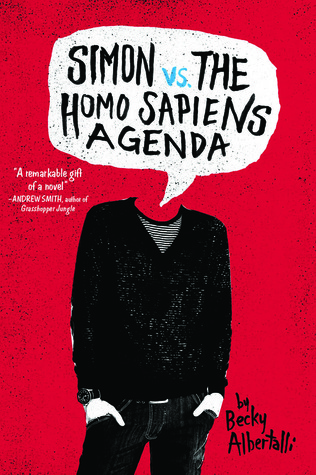
Simon vs. The Homo Sapiens Agenda


The problem with reading book summaries is that they often focus on some aspect of the plot that might seem "gimmicky" (at least to this reader), and that can put me off.  Neither the title nor the "hook" of this book encouraged me to read it, despite the almost universal acclaim.  If you have been similarly disinclined, let me reassure you:  this book is a must-read for fans of contemporary Young Adult literature.  It is frank, funny, warm and has such a great voice.  Author Becky Albertalli is a clinical psychologist who works with teenagers, and her love and respect for her subject shines through every aspect of this book.

The plot kicks off with 16 year-old Simon Spier engaging in a highly secretive email exchange with another boy in his school.  Through the freedom of an anonymous email account, Simon (aka Jacques) is exploring the possibility that he might be, probably is in fact, gay.  Neither Simon nor his confidante "Blue" is ready to come out, even to each other, but their email confidences gradually deepen into a relationship which is important to both of them.  So here's the rub, and nub of the plot: Simon gets busted by Martin, an acquaintance in his drama group.  Martin proposes a deal (ie, blackmail):  He will keep Simon's secret, as long as Simon champions his courtship of Abby (an alpha female who happens to be one of Simon's best friends).  Although Simon's "coming out" is the central drama of the plot-line, the book is exceptionally strong on friendship.  For most people in this age group, friendships are far more important than romantic relationships -- and this is underscored over and over again through Simon's bumpy progress towards romantic happiness.

There were was so much to admire in this book, but I particularly appreciated the active presence of loving parents.  There are so many examples of dysfunctional or completely absent parents in YA literature; sadly, it is almost a novelty to find a positive (yet realistically so) parent-child relationship. Probably the worst thing about Simon's father, in particular, is that he makes the common mistake of being tragically "hip".  Not only does this result in tasteless jokes, but it also defies that generational law:  Thou Shalt Not be Hipper Than Thy Teenager.  Even teenagers from close families need their emotional space, and I haven't met a teenager yet who wants to discuss his or her sex life with parents.  One of the funniest lines in the book, at least for me, was Simon's rueful acknowledgement that his parents' eager desire to "share" with their children could be "more exhausting than keeping a blog."

We still live in a world where most parents, no matter how liberal and loving, will have a bit of an emotional adjustment period at the revelation that their child is gay -- if only because of worry for the greater difficulties that their child may face.  One of the things that Albertalli gets exactly right is that she creates something close to a best-case scenario -- good friends, supportive parents -- and then she acknowledges that "coming out" is still a difficult thing.  The truly genius thing about this book, though, is that it is so much more than a coming out story of one boy.  Simon knows his parents will accept his sexuality with grace; the thing that really worries him is the scrutiny.  Adolescence is a time of great flux -- of figuring out how you are -- and that can be both tiring and painful.  As Simon puts it:

All I ever do is come out.  I try not to change, but I keep changing in all these tiny ways.  I get a girlfriend.  I have a beer.  And every freaking time, I have to introduce myself to the universe all over again. 


Click icon for more
book review blogs
@Barrie Summy


This book appears on TRAC's First Love reading list.  Please visit the TRAC website for more details about the Teen Reading Action Campaign.

Friday, 14 August 2015

LGBT themes in contemporary YA


I recently reread that classic YA novel The Catcher in the Rye-- one of my own adolescent favourites -- for the first time since the 1980s.  According to The Guardian, it ranks as the 72nd best novel of all time.  Robert McCrum's excellent short piece on the "defining novel of teenage angst and alienation" happens to mention that "by 1981, it was the second most taught book in the United States." Certainly it was on the required reading list of my small town Texas high school -- despite the drinking, smoking, sex and profanity that made the book so infamous.  A friend who observed me reading the book wondered if I found it "dated" in 2015.  The truth is that its 1949 New York City setting was already "historical" when I was reading the book in 1981. The way that Holden spoke, the particular slangy language he favoured, was already unrecognisable to a 1980s teenager. But the eternal, durable qualities of the book -- mostly the poignant, hilarious, distinctive voice of Holden Caulfield -- were pretty much intact in 2015, and not much diminished since my first reading experience.  The only aspect of my rereading that I found really quite different was my awareness of an undercurrent of homosexuality running through the book.

Towards the end of the book, Holden spends the night with one of his former teachers -- a Mr. Antonlini, who is presented is a heavy drinker recently married to an older woman "lousy with dough".  Holden wakes up on the couch to discover that Mr. Antonlini is "sort of petting me or patting me on the goddamn head".  Holden bolts from the apartment in a complete panic, even though it is the middle of the night.  Although he acknowledges that he might have misinterpreted the situation -- thus, making it grey area for the reader's interpretation as well -- he also comments that "when something perverty like that happens, I start sweating like a bastard.  That kind of stuff has happened to me about twenty times since I was a kid.  I can't stand it." (p. 174)

My intention is neither to prove or disprove Holden's possible homosexuality -- although this blog post makes a really plausible case for the former, if you are interested -- but rather to point that how very much the world has changed since The Catcher in the Rye was published in 1951 . . . or even since I first read the novel in 1981.  Did I pick up on Holden's "protest too much" diatribe against all things "perverty" as ambivalence when I first read the book?  It's doubtful.  At the time, one of my best friends was a lesbian -- not that we even had a word for it, much less realised that her unhappiness might have something to do with repressed sexuality.  I thought she was a "punk" -- mostly because she favoured safety pins as a fashion accessory and was the only person I knew who listened to The Sex Pistols and the Dead Kennedys.  She was the first person I knew who self-harmed, and we didn't have a word for that, either.

The present generation of 13-25 year olds live in an entirely different world when it comes to LGBT rights and self-expression.  June, 26, 2015 was the landmark date on which the United States Supreme Court ruled in Obergefell v. Hodges that same-sex marriage cannot be prohibited by a state.  Considering that homosexual activity was illegal during 1951, and indeed not technically legal in all states until June 26, 2003, a mere 12 years in a nation's history are the entire formative years of a present-day 25 year-old.  What might seem a gradual softening of attitude to a 45 year-old or a 70 year-old is just the way it has always been to someone who is currently 15 years-old.  No surprise then that the current generation of adolescents are entirely more comfortable with, and approving of, LGBT rights than previous generations.  This is certainly reflected in YA fiction.

One of the reasons that Holden's discomfort with "perverty" behavior so jarred is that I read The Catcher in the Rye just after completing a reading list of contemporary realistic fiction.  In I'll Give You the Sun, the male protagonist falls in love for the first time -- and has his feelings returned, although the baseball player that he falls for must battle some homophobic attitudes in the sports world.  In Grasshopper Jungle and This Is Not a Love Story, the main characters experience their sexuality as a bisexual spectrum.  Although having sexual feeling for both sexes is not presented as unproblematic, it is definitely presented as something entirely normal and typical.  In Me Being Me is Exactly as Insane as You Being You, the protagonist's father has come out as gay -- which has precipitated the parents' divorce.  Although the young male narrator has some discomfort with this change in his life, as I said in my review of this book, the discomfort is more to do with change in general than his father's homosexuality in specific.  Recently I read Holly Black's new fantasy novel The Darkest Part of the Forest in which a faerie prince is rescued by a teenage girl, but then falls in love with her older brother.  Yes, the author delights in subverting all of the usual fairy tale conventions, but she is also reflecting a world in which this outcome is seen as equally possible.

Some aspects of adolescence haven't changed all that much in the last 65 years  -- hopefully, adolescents will always be more innocent and idealistic than their life-bruised elders -- but when it comes to sexuality, it is a braver, more permissive world out there.

Visit TRAC's website to see the complete list of YA Classics and Hot for Summer contemporary fiction.

Wednesday, 17 June 2015

Me Being Me Is Exactly as Insane as You Being You


15 year-old Darren Jacobs is grappling with:
1) his parents' recent divorce
2) his father's coming out as gay
3) his body image
4) his sexual feelings
5) his confused emotions about at least 2 girls
6) the way that his parents suddenly seem like different people
7) the way that his parents have lives that don't necessarily have him at the center
8) general weirdness

Like Judy Blume, that trailblazer of realism in children's and YA literature, author Todd Hasak-Lawy speaks candidly about the body and adolescent sexual awareness.  Darren might be awkward and self-conscious and mute, more often than not, but the voice of the narrative is self-assured.  Darren's anger, confusion, contrariness and monosyllabic tendencies seem entirely appropriate for his age, gender and situation in life.

There seems to be a trend in realistic YA fiction for strong language (which was not so present in Blume's writing), sexuality and references to drugs and alcohol.  It may not be what parents want their children to read (ie, a sanitized version of of adolescent life), but it probably rings truer for the life that most adolescents are experiencing.  Also:  Is just me, or does it seem like LGBT themes and characters and storylines are really pervasive at the moment?  Fun Home just won 5 Tony awards, Caitlyn Jenner is on the cover of Vanity Fair, and the last three realistic YA novels I have read all feature a gay character -- and not even as the protagonist or the main theme, but in a studiously casual way . . . as if to say, "this is just our new normal".  Darren is not completely comfortable with his father being gay, but it's not really the homosexuality per se as much as the fact that his life is changing too quickly.  It's just one of many things that Darren is dealing with, and the storyline deals with it in straightforward, sensitive way.  Like most adolescents, (if not all), Darren is much more interested in his own sexual experiences than his father's.

It's difficult to stand out in a crowded YA field, but this book will be remembered as "the list" book -- and maybe for its catchy title (which suits a story in which there is father-son therapy and a love interest in rehab).  The narrative is told through a series of lists -- some of them brief, and some of them so lengthy that they threaten to stretch the concept to its breaking-point.  It is an arguably gimmicky way of telling a story, but it mostly works.  Much of the humour of the book takes place between the title of the lists and their contents.  It also is an efficient way of breaking up the text, which is always a plus for reluctant readers, male readers, impatient readers and readers who read a lot for their work (me).  Unfortunately, and this would be my main criticism of the book, the overall length of this book starts making even an indulgent and (mostly) entertained reader feel:  enough already.  Didn't YA books used to be between 180-200 pages on average?  Just because J.K. Rowling wrote door-stoppers that sold millions doesn't mean that every YA author needs to deliver such a high word-count.  This story would have greatly benefited from being more tightly edited.  It just goes on a bit too long, even though its separate parts are both entertaining and worthwhile.


Click icon for more
book review blogs
@Barrie Summy