Showing posts with label World War I. Show all posts

Wednesday, 11 November 2015

Poppy


In Flanders field the poppies blow
Between the crosses, row on row,
That mark our place; and in the sky
The larks, still bravely singing, fly
Scarce heard amid the guns below 

John McCrae 'In Flanders Fields', Essex Farm 1915


For several weeks before Armistace Day, the cheerful red poppies associated with the Royal British Legion's annual Poppy Appeal are omnipresent in England.  Every schoolchild knows that they are associated with World War I:  with 'remembrance', with honouring the dead, with supporting the armed forces.  The two minute silence is honoured all over the country, but I wonder how many young people are focusing their thoughts on sacrifices made so long ago?  For those who do not have a specific family member to remember, is there another way to make a mental and emotional connection with 'historical' events?  I would argue 'yes'.  A well-told story has the ability to powerfully concentrate the mind, and there are several recently published UKYA novels that truly do bring World War I back to life again. 

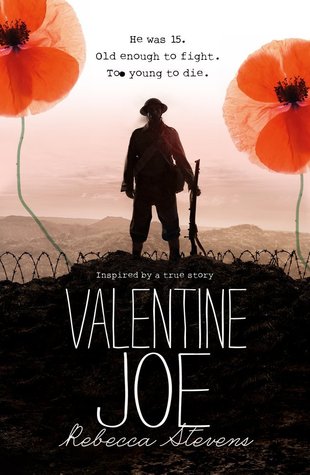
Rebecca Stevens published Valentine Joe in 2014, the centenary of the beginning of the war. Valentine Joe Strudwick was a real person; he died at Ypres at the age of 15, and was buried in the Essex Farm cemetery immortalized by John McCrae's famous poem.  In this unusual novel, a contemporary storyline is skilfully woven together with the historical one.  Rose and her Grandad are visiting Essex Farm when she spots Valentine Joe's gravestone.  Rose is still in mourning for her own father, who has recently died.  Through the device of a scrappy stray dog called Tommy, Rose manages to time-travel back to the battleground of Ypres and meet Joe.  Rose's state of mind is so attuned to grief and loss that she is able to connect directly with Joe, and in a very sweet and subtle way they each manage to heal something in the other.  History really is brought back to life in this book. 

Mary Hooper, a name particularly associated with historical fiction for young adults, has published two novels in the last 18 months which view the 'War to End All Wars' from the perspective of Poppy Pearson, a young VAD nurse.  At the beginning of the war, Poppy is working in 'service' as a parlourmaid for the de Vere family.  Poppy is intelligent and able, but social class and lack of money -- her mother has been widowed with four children -- have narrowed her options.  The war brought many unexpected social changes, particularly for women, and Poppy is able to develop useful skills, travel and mix with other social classes precisely because qualified nurses were in such demand.   Initially, Poppy is attached to a hospital in Southampton; later, in Poppy in the Field, she nurses wounded and dying men in France.  The storyline touches on how the brutality of trench warfare forced improvements and innovations in medical care -- everything from the mental illness described as 'shell shock' to experimentation in plastic surgery and prosthetics.   Throughout both novels, the broken bodies and spirits that Poppy tends to are made very real.  There is one particular scene in which Poppy has to clean up a soldier nicknamed 'Tibs' who has came straight from the battlefield. The description of Poppy cutting off Tibs' boots, and discovering an advanced case of trench foot, is not one that I will soon forget.  But having said that, the narration is far from melodramatic.  The novel has many poignant moments; but considering the source material, how could it be otherwise?
World War I changed the world in many ways, but one enduring legacy has been a change in the way war itself is viewed. 


Wednesday, 14 October 2015

Cuckoo Song


After a mostly glorious and golden beginning to October, today was the first day when I really felt the in-betweenness of the seasons.  The wind, brisk and biting, definitely had the chill of winter.  I have been reading lots of ghost stories lately -- not really my favourite genre, but I like them when the "ghost" is more of a subtle, symbolic thing.

Halloween and Guy Fawkes Day and Remembrance Day have a tendency to slide together in England, as they all take place within two weeks and just at that time of the year when Daylight Savings conspires with the natural dying of the day and plunges us all into darkness.  If you really want to go with that mood, I don't think you can do much better than Frances Hardinge's Cuckoo Song.

There is a ghost in the house at The Beeches, Luther Square, Ellchester.  The father of the house may be Mr. Piers Crescent, civil engineer and designer of the railway bridges and station which will save Ellchester, but he hasn't been able to save Sebastian -- his oldest child, and only son, who died in the final months of the Great War.  Although Mr. Crescent has done his best to stop time, and wrap his daughters Triss and Pen in cotton-wool, he has made something of a bad bargain (literally) with a sinister Architect.  The entire family has been arrested in a prolonged state of grieving, and the inability of the parents to let go of their dead son has lead, directly, to the events which take place in this novel.

The War had ended, but it was not gone.  Somehow it was still everywhere.  Sebastian was the same. He had ended but he was not gone.

Like all the best children's books, this book operates on two levels -- thus making it appropriate for ALL ages. On the more surface level, this book is about a changeling (a "cuckoo") who is substituted for a real girl. Only gradually does "Triss" realise that she is actually a not-Triss -- and just a "monster" or made-up thing with an expiration date.    Unlike the real Triss, not-Triss (who later becomes Trista) is "allowed" to be something other than the "sweet, quiet, well-behaved girl" that her parents expect and want.  She has agency; she does things and makes things happen.  She eats dolls instead of playing with them.   Somewhat like Alice's Adventures in Wonderland, not-Triss ventures into an alternate world -- the world of the Besiders -- and uses her wits to bargain for something which will change the outcome of not just her brief existence, but lots of other realities, too.

But there is a more complex level to this book; truly,  I think that all of the best fantasy novels have that ability to throw some light on what we like to call the "real" world.  That aspect of the book deals with the aftermath of World War I and how it impacts not just one grieving family but an entire society. The novel manages to take in the changing role of women -- and there is fascinating commentary here about the "containment" of the feminine -- but also how the war changed the "certainties" (religious faith and class structure) of the country.

One of the subversive female characters is Violet Parish, the former fiancée of Sebastian.  She has bobbed hair, rackety friends, a variety of short-term jobs and she drives a motorcycle; she drinks and smokes and is generally "fast".  She also takes in Pen and Triss when no one else will.


Once she had been 'Violet'.  After Sebastian's departure she had been 'poor Violet'.  And then somehow, in the years since his death, her name had blackened and speckled in Triss's family home, like a fruit left to rot, until it was thrown out and no longer allowed in the house.
A specific pleasure of this book is the quality of the writing; Hardinge has a wonderfully expressive way with words.  I cannot think of another writer who uses figurative language with such fresh precision.  I felt, often, the urge to copy sentences and paragraphs down -- to capture the words for myself -- just because they pleased me so much.   It wasn't a book that I would have sought out if left to follow my usual tastes, but it was a suspenseful, thoughtful and pleasurable reading experience.


Click icon for more
book review blogs
@Barrie Summy

Tuesday, 11 November 2014

Remembrance Day

This year's Remembrance Day commemoration has focused on the 100th year anniversary of the advent of World War I -- represented, so poignantly, in the Blood Swept Lands and Seas of Red art installation currently seen at the Tower of London.   November 11 marks the day that the last of 888,246 ceramic poppies -- each representing a British or colonial death in the "War to End All Wars" -- is laid to rest.

I have read a number of novels set in World War I, but for me the classic and still indispensable text is All Quiet on the Western Front by Erich Maria Remarque.  Published in 1929, it is still surprisingly accessible and readable.  For the British or American reader, there is always that shock of perspective.  Rather than despise the narrator, we sympathise and suffer with him.  We root for him; we hope he can outwit the many forces which want to crush him.  There is no faceless enemy, no German "Hun", but only a young Paul Bäumer -- who was sold a jingoistic bill of goods, just like every other young man of his generation.  Although the novel describes a war dominated by trench warfare, the conditions of war seem applicable to almost any armed conflict.   Rather than excitement and glory, Paul experiences boredom interspersed with intervals of sharp fear.  Scavenging for food and cigarettes is his and every other soldier's main concern, and comradeship their only consolation.  Paul fears that the experience of war has left him fit for no other purpose and the random nature of survival alienates him from even his closest comrades.  In one sense, that is the irony of the novel.  War has often been criticised for being a soulless machine, but in this war story,  the individual's experience is the only important thing.

Although the number of 888,246 is huge and shocking, it seems worth noting that German casualties were more than twice that number.    The total casualties of the war are believed to be larger than 10 million human lives.  We honour those sacrifices even as we acknowledge the pointlessness of so many of them.   As the infographic at poppyfield.org shows, the "Great War" wasn't the war to end all wars . . . not even close.